
TWO-YEAR-OLD PRESCHOOL · 24–36 MONTHS
Two changes everything.
MORE WORDS. · MORE INDEPENDENCE. · MORE POSSIBILITIES.
At two, children suddenly seem capable of so much more. They’re talking, running, remembering, making choices, noticing their friends — and developing some very strong opinions along the way.
The classroom begins to grow with them.
Teachers introduce more structure, more involved activities, and new opportunities to follow directions, solve problems, work with friends, and explore early literacy, math, science, art, and language.
They’re still little.
But they’re ready for more.

THEY KNOW MORE. SELF-CONTROL TAKES LONGER.
Knowing the rule and being able to follow it are two different skills.
Two-year-olds can understand a rule and still have trouble following it in the moment.
The harder work is stopping the impulse, finding the words, noticing what another child needs, and deciding what to do next.
That is where the teacher comes in.
01
THE WANT
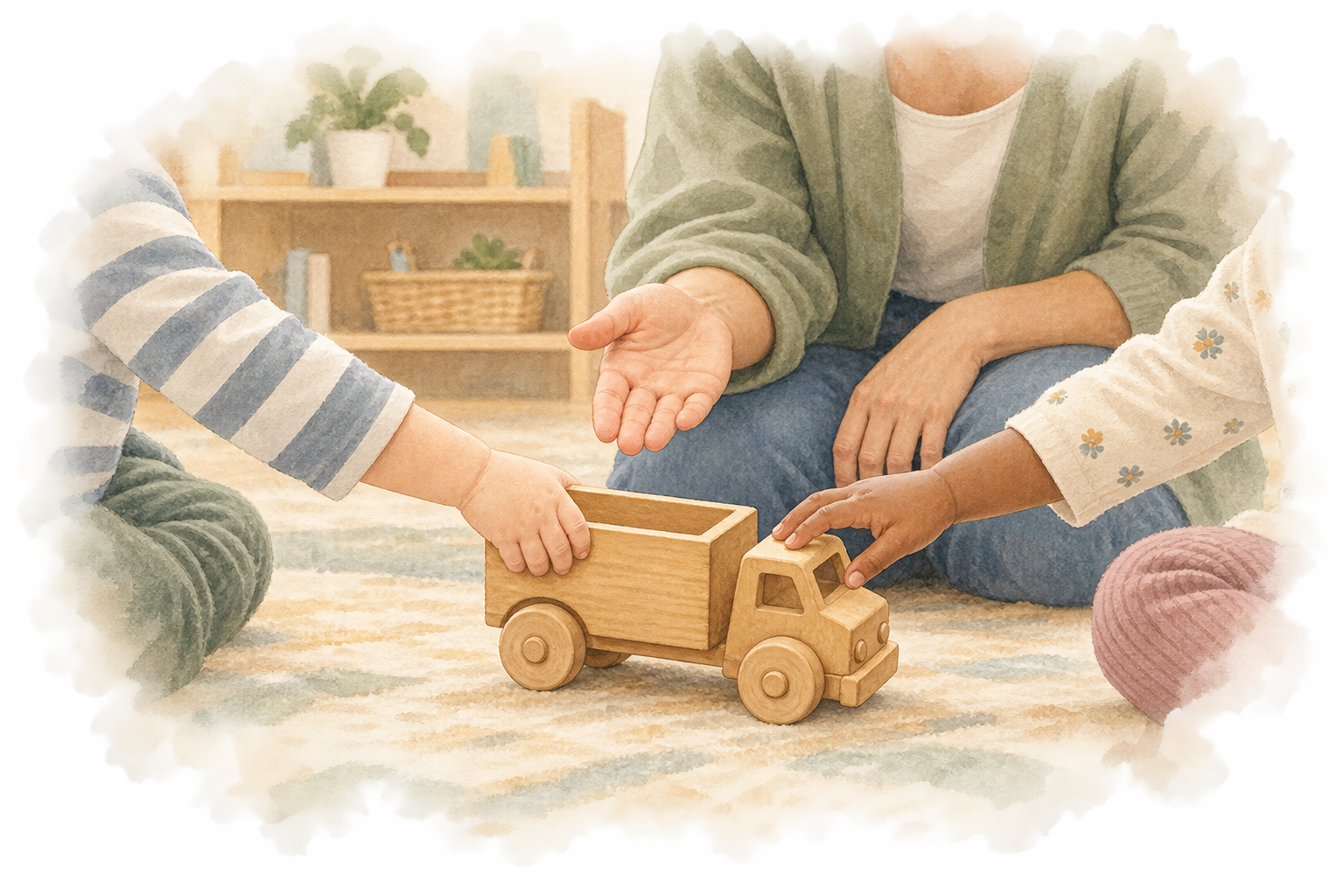
“I want that truck.”
The child knows what they want, but the impulse to reach for it may come before the words.
TEACHER LENS
Recognizing the need + beginning impulse control
02
THE WORDS
“Can I have a turn when you’re done?”
The teacher helps the child turn the impulse into language they can use with another person.
TEACHER LENS
Expressive language + social communication
03
THE OTHER CHILD
“I’m using it.”
Now there is another perspective to consider. The other child has a want, a voice, and a turn, too.
TEACHER LENS
Social awareness + beginning perspective-taking
04
WHAT HAPPENS NEXT
Wait.
Choose something else.
Stay nearby.
Try again later.
Asking doesn’t always mean getting an immediate yes. Children begin practicing how to handle the answer and decide what to do next.
TEACHER LENS
Waiting + flexibility + self-control + problem-solving
WHAT THE TEACHER IS REALLY WORKING ON
What looks like a small conflict over a truck can give children practice noticing another person, communicating what they need, hearing an answer, and staying in the interaction when they don’t immediately get what they want.
A grabbed truck looks like a small classroom conflict.
To a teacher, it can be practice for a relationship.
EMERGENT CURRICULUM
Their curiosity starts the lesson.
Our teachers decide how far it can go.
At two, children’s interests can last longer than a moment. A truck, a puddle, a bug, a shadow, or something happening outside the window can become the beginning of much more.
What can we teach through this?
THEY NOTICE
A puddle.
“Big puddle!”
The idea begins to travel.
SCIENCE
- Where did the water come from?
- What happens when water sits in the sun?
- What floats? What sinks?
Observation + prediction + cause and effect
MATH
- Full and empty.
- More and less.
- Big container, small container.
- Count the scoops.
Quantity + comparison + early measurement
LITERACY & LANGUAGE
- Read a related book.
- Talk about what happened.
- Ask children what they noticed.
Vocabulary + conversation + comprehension
ART + NOTEBOOK
“What happened to our puddle?”
- Children draw what they remember or noticed.
- The teacher may record the child’s words alongside the drawing.
Representation + fine-motor development + early writing
WHAT THE TEACHER SEES
The puddle is the interest. The learning underneath it is observation, language, comparison, prediction, representation, and problem-solving.
The topic came from the child.
The depth comes from the teacher.
THE LESSON CAN GROW WITH THEM
Their attention is growing.
So the lesson can grow, too.
At two, children can begin staying with an idea longer. They can listen, try something, remember what happened, and sometimes come back to it again.
That gives teachers more room to build.
Activities can include more steps. Questions can go a little deeper. Materials can be used in new ways. And small-group experiences can begin asking children to listen, participate, make choices, and remember what comes next.
EARLIER
Touch it.
Try it.
Move on.
Early exploration may be brief. A child touches the material, discovers something about it, and moves toward whatever catches their attention next.
That exploration matters.
It gives teachers information about what interests the child and what they may be ready to try next.
AS THEIR ATTENTION GROWS
Listen.
Try.
Remember.
Return.
Now the same child may stay longer, listen to a short explanation, try more than one step, remember what happened, and return to the idea later.
That growing attention gives teachers opportunities to make learning more involved without making it less playful.
We don’t make the child fit a harder lesson.
We make the lesson more involved when the child is ready for more.
WHAT GROWING ATTENTION MAKES POSSIBLE
SMALL-GROUP LEARNING
Children begin participating in experiences with a few classmates — listening, watching, taking turns, and contributing.
SHORT SEQUENCES
“Get your paper, choose a crayon, and come sit with us.”
Teachers can gradually introduce familiar directions with more than one part as children show they are ready.
REVISITING AN IDEA
Something discovered outside in the morning can return in a book, conversation, drawing, or activity later.
MORE INVOLVED MATERIALS
Children can begin using materials with greater purpose — sorting, matching, building, drawing, comparing, arranging, pouring, and investigating.
WHAT THE TEACHER IS WATCHING
Can they stay with it a little longer?
Can they remember what came first?
Can they follow the next familiar direction?
Are they ready for another layer?
The answer helps the teacher decide what to offer next.
More structure doesn’t mean asking two-year-olds to act like older preschoolers.
It means giving them enough predictability to know what is happening — and enough challenge to keep growing.
The goal isn’t to keep them busy longer.
It’s to notice when they’re ready to think a little farther.
THE COMPOSITION NOTEBOOK
The notebook stays. The child changes.
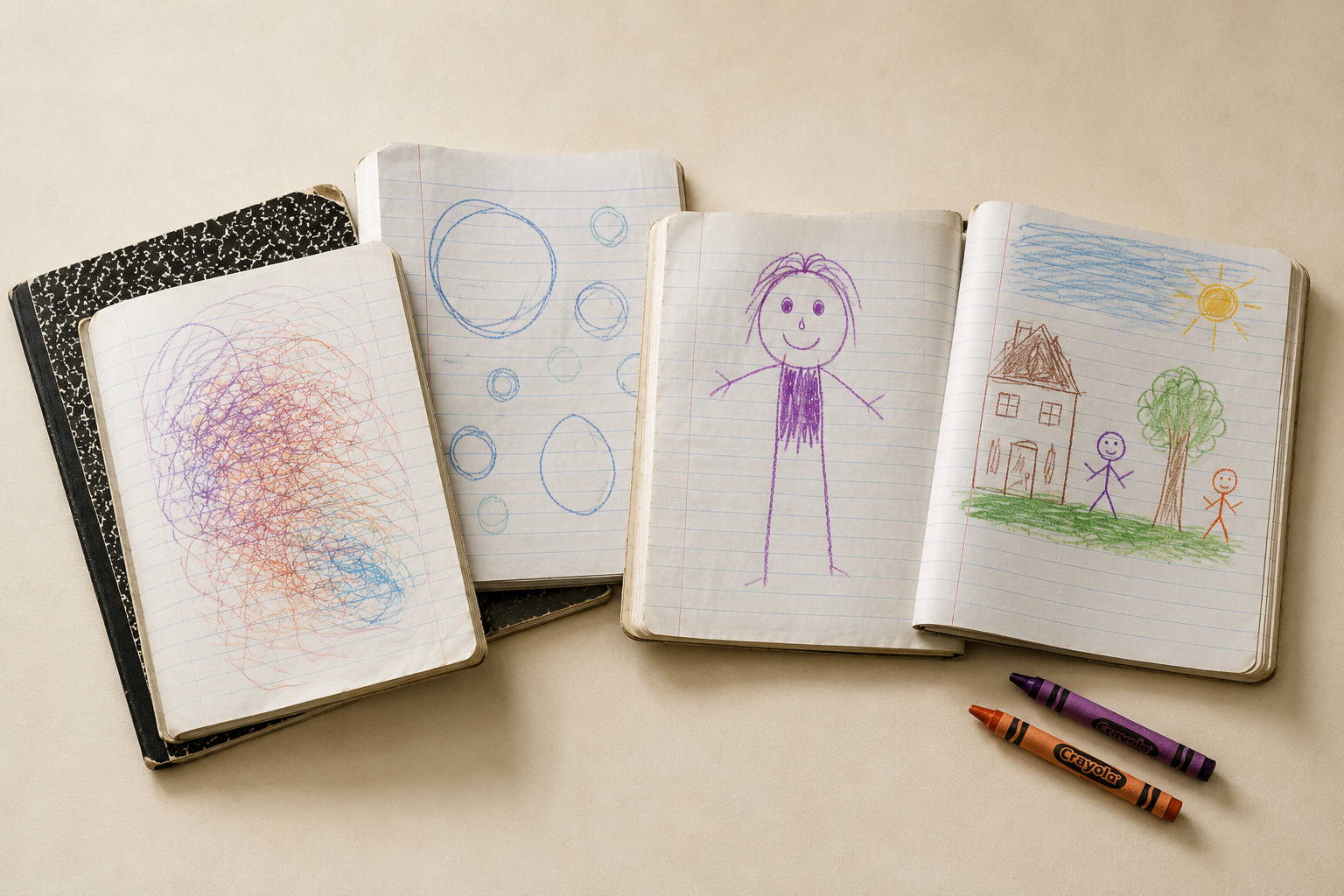
We begin composition notebooks in the Two-Year-Old classroom. Children respond to questions through drawing and conversation, creating pages that begin to show us how they see and understand the world.
01 FIRST MARKS
The first marks may simply be the joy of discovering, “I can make something appear on this page.”
02 SOMETHING BEGINS TO FORM
Marks begin becoming shapes, and shapes begin carrying meaning.
03 “THAT’S ME.”
A drawing begins representing an actual idea, person, or experience.
04 A STORY APPEARS
Eventually the picture has more to say—and so does the child describing it.
The drawing tells us something.
Their words can tell us even more.
Teachers ask questions, listen to children’s explanations, and may record their words alongside the drawing—helping preserve both the picture and the thinking behind it.
WHAT LOOKS LIKE DRAWING IS ALSO PRACTICE IN
Fine-motor control · Representation · Vocabulary · Memory · Early writing · Storytelling
One notebook. Hundreds of small changes you can actually see.
LEARNING CENTERS
Different spaces. Different ways to think.
At two, the classroom begins offering more defined spaces for children to explore ideas in different ways. Teachers prepare materials around what children are learning, then help them choose, investigate, practice, and return to those ideas throughout the day.
Literacy & Language
Books, conversation, storytelling, new vocabulary, composition notebooks, names, and the first connections between spoken words, pictures, and print.
Math
Counting, sorting, matching, comparing, patterns, shapes, size, quantity, and solving small problems with real materials.
Science & Sensory
Observing, pouring, predicting, noticing change, exploring texture, asking questions, and discovering what happens when they try something.
Art & Fine Motor
Drawing, painting, clay, collage, grasping, squeezing, tearing, placing, and beginning to represent ideas through materials.
Building & Dramatic Play
Blocks, pretend play, familiar roles, problem-solving, language, cooperation, and figuring out how things fit together.
The centers change as the learning changes.
A topic introduced at circle time might show up later in a book, at the art table, inside a building project, or in something children investigate together.
Teachers choose the materials. Children help show us where the exploration should go next.
One classroom. A lot of ways to think.
LEARNING TO BE WITH OTHER PEOPLE
Friendship takes practice, too.
At two, other children start becoming much more interesting. They notice who’s here, who has the toy they want, who makes them laugh, and who they want to sit beside.
Those relationships bring wonderful moments — and plenty of complicated ones. Our teachers help children learn that being with other people means communicating, listening, noticing feelings, and sometimes figuring out how to make things better after something goes wrong.
Finding each other
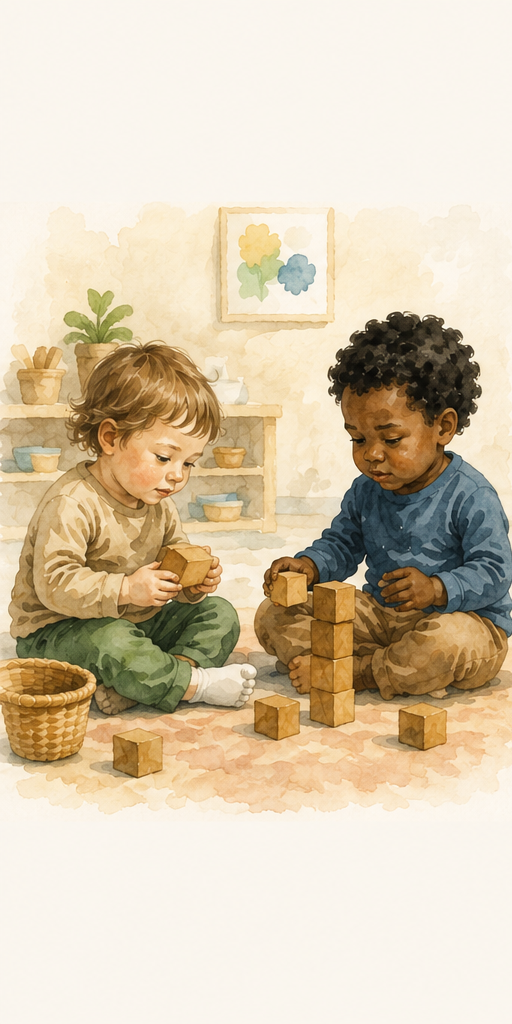
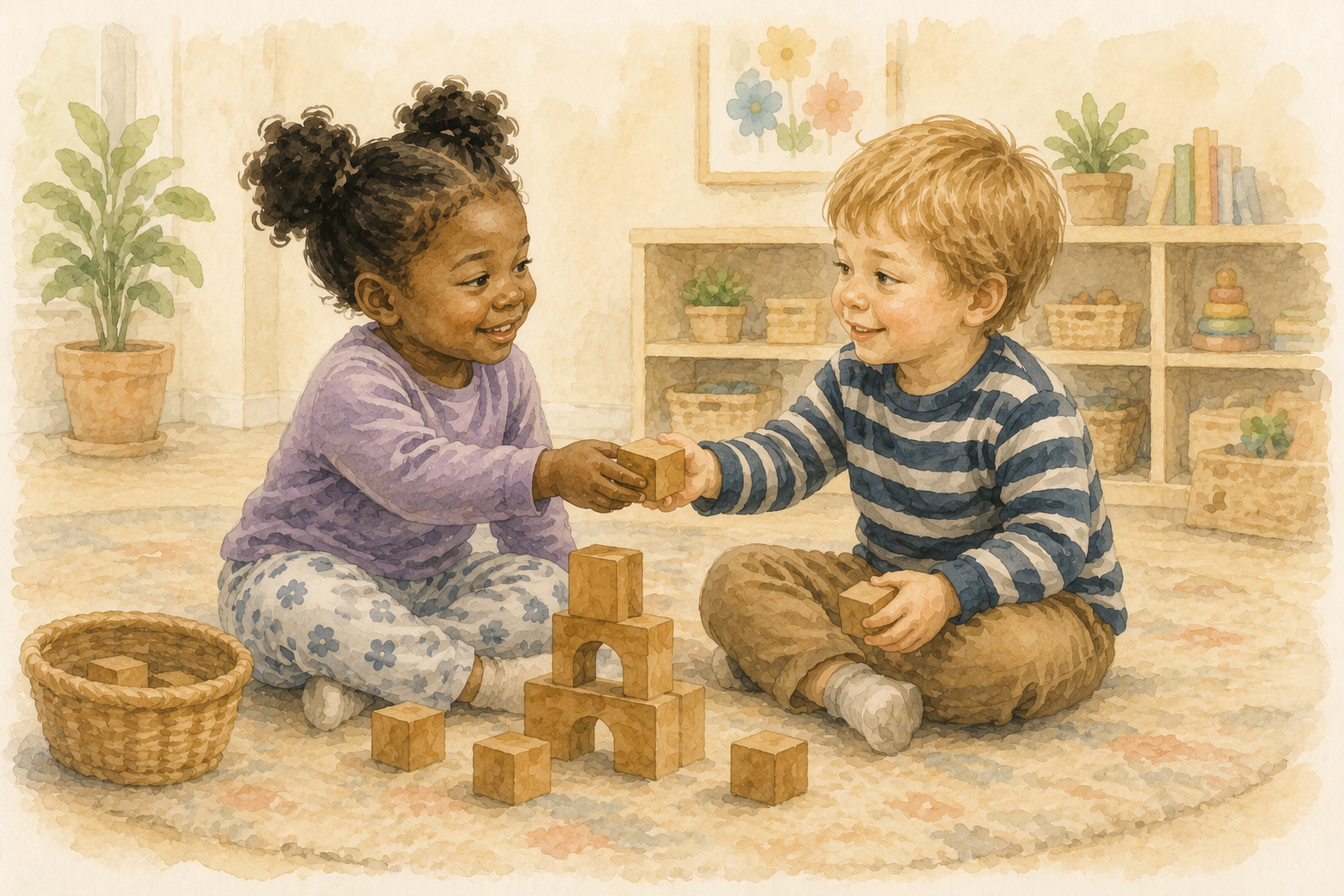
Children begin recognizing familiar classmates, seeking them out, copying what they’re doing, and discovering that playing near someone can slowly become playing together.
Learning that another person has feelings, too
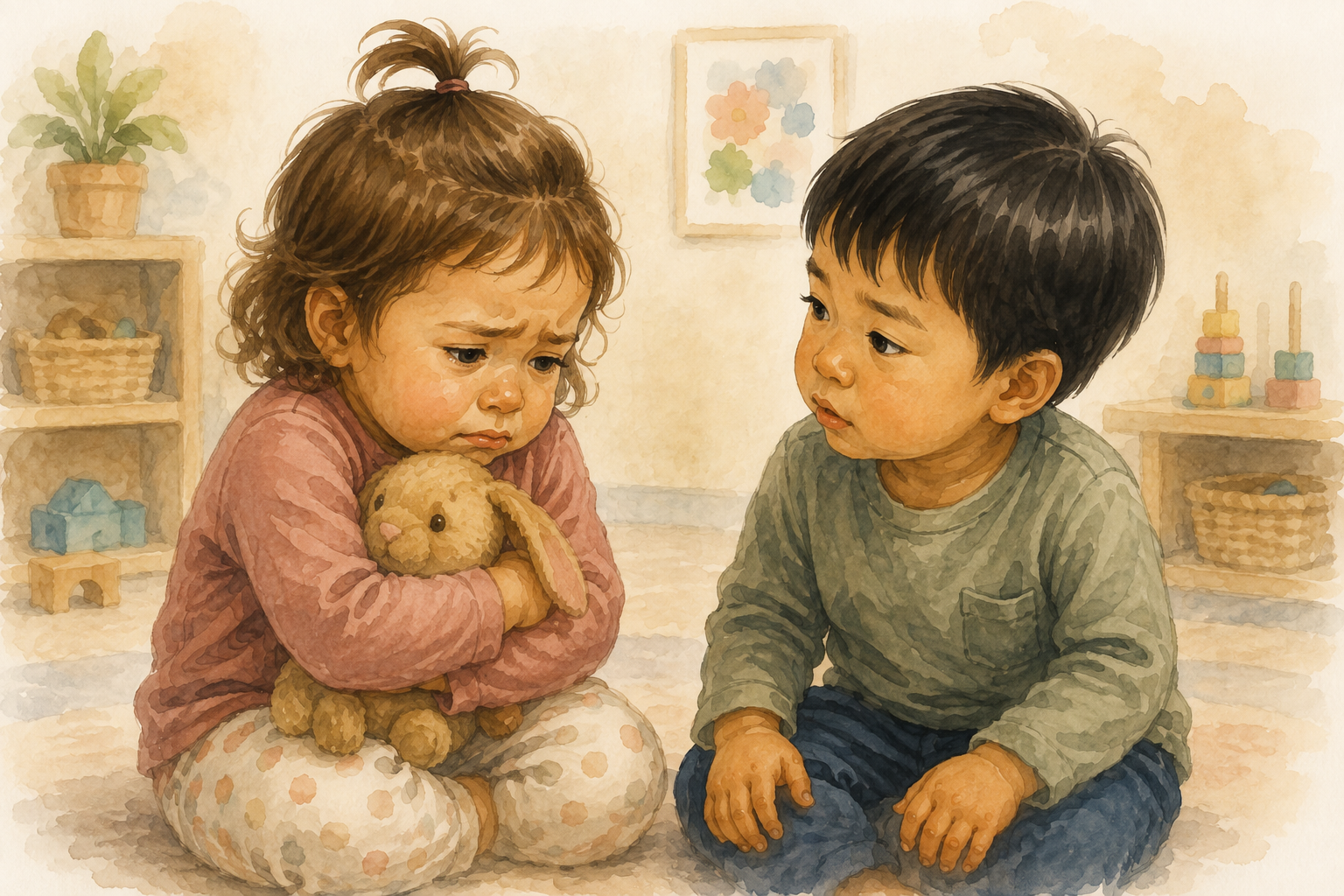
A friend may want something different, say no, move away, or become upset. Teachers help children begin noticing those reactions and understanding that another child’s feelings matter, too.
Learning how to reconnect
When something goes wrong, the lesson doesn’t have to end with “say sorry.” Teachers can help children notice what happened, check on the other child, use words, and begin learning how relationships can recover after a difficult moment.
The goal isn’t to prevent every disagreement. It’s to help children learn what to do inside one.
SOCIAL AWARENESS · LANGUAGE · EMPATHY · TURN-TAKING · FLEXIBILITY · RELATIONSHIP REPAIR
At first, another child is simply someone else in the room.
Then, slowly, they become someone who matters.
DOING MORE FOR THEMSELVES
Independence starts becoming responsibility.
At two, independence starts looking like more than wanting to do everything alone. Children begin remembering familiar expectations and taking a bigger role in caring for themselves, their belongings, and the classroom around them.
Teachers still help — but increasingly, we leave room for the child to do the part they’re ready to do.
PUTTING AWAY BELONGINGS
Children begin learning where their things belong and taking part in putting them there.
MEALS
They carry, eat, drink, and clean up with increasing independence as their skills allow.
HANDWASHING & SELF-CARE
Familiar routines become things children increasingly participate in rather than things adults simply do for them.
CLASSROOM RESPONSIBILITY
Putting materials back, helping clean up, and caring for shared spaces teaches children that they are part of the classroom community.
CLOTHING
Coats, shoes, and simple clothing tasks become opportunities to try before an adult automatically steps in.
Doing it for a child is often faster.
Letting them try is where the learning happens.
ANOTHER KIND OF INDEPENDENCE
Potty learning starts with readiness.
For many children, the Two-Year-Old classroom is also when potty learning becomes a bigger part of the conversation. Teachers watch for readiness, talk with families about what they’re seeing, and work together so the child receives a consistent message at home and at school.
We don’t expect every child to be ready on the same day. As readiness develops, children begin noticing body cues, communicating what they need, managing clothing with more independence, and becoming increasingly involved in the process themselves.
When home and school use familiar expectations and language, children have an easier time understanding what we’re asking them to practice.
The goal isn’t to do everything alone.
It’s to discover how much they’re becoming capable of doing.
PART OF THEIR WEEK. PART OF YOUR COMMUNITY.
There is more to school than what happens during a lesson.
Children begin building a world at school that extends beyond their classroom — new teachers, new experiences, friendships, and familiar faces they look forward to seeing.
Families become part of that world, too.
Spanish becomes part of their school experience.
A dedicated Spanish teacher works with children through familiar words, songs, movement, repetition, books, and age-appropriate concepts. At two, we are building familiarity — helping children hear another language, connect words with meaning, and become increasingly comfortable using what they recognize.
DID YOU KNOW?
Exposure to more than one language does not cause language delays. Young children can learn and communicate across more than one language while their language skills are developing.
Music is one of the days they learn to look forward to.
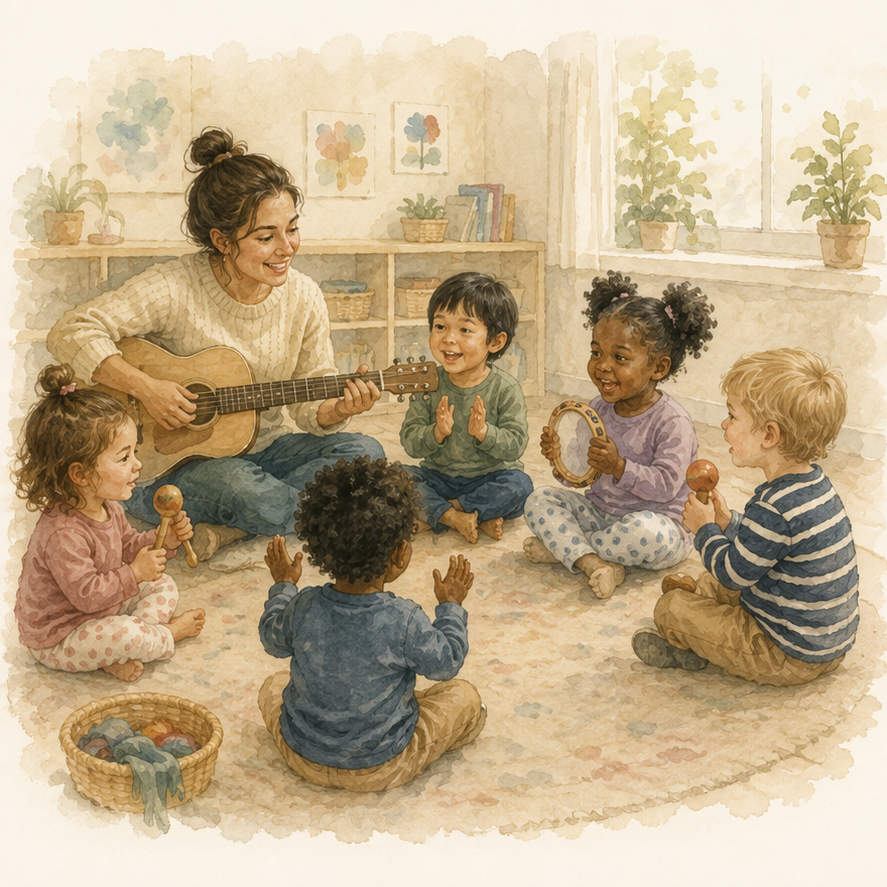
Each week, outside music specialists come into L&L with planned experiences created for young children. Children sing, listen, clap, move, follow patterns, experiment with sound, and participate together.
It is learning — but to a two-year-old, it mostly feels like a really good time.
DID YOU KNOW?
Music and movement can support young children’s language, social-emotional, cognitive, communication, and physical development.
Music is one of the days they learn to look forward to.
Each week, outside music specialists come into L&L with planned experiences created for young children. Children sing, listen, clap, move, follow patterns, experiment with sound, and participate together.
It is learning — but to a two-year-old, it mostly feels like a really good time.
DID YOU KNOW?
Music and movement can support young children’s language, social-emotional, cognitive, communication, and physical development.
You shouldn’t have to wonder what their school life looks like.
Brightwheel helps families stay connected through photos, updates, and messages. But communication doesn’t stop inside an app. Teachers also talk with families about what they’re noticing — new skills, friendships, challenges, interests, and changes that may be showing up at school.
Parent-teacher conferences give families and teachers time to look more closely at development, talk about what we’re seeing at school and at home, and discuss what children may be ready to work on next.
And somewhere along the way, parents start finding each other, too.
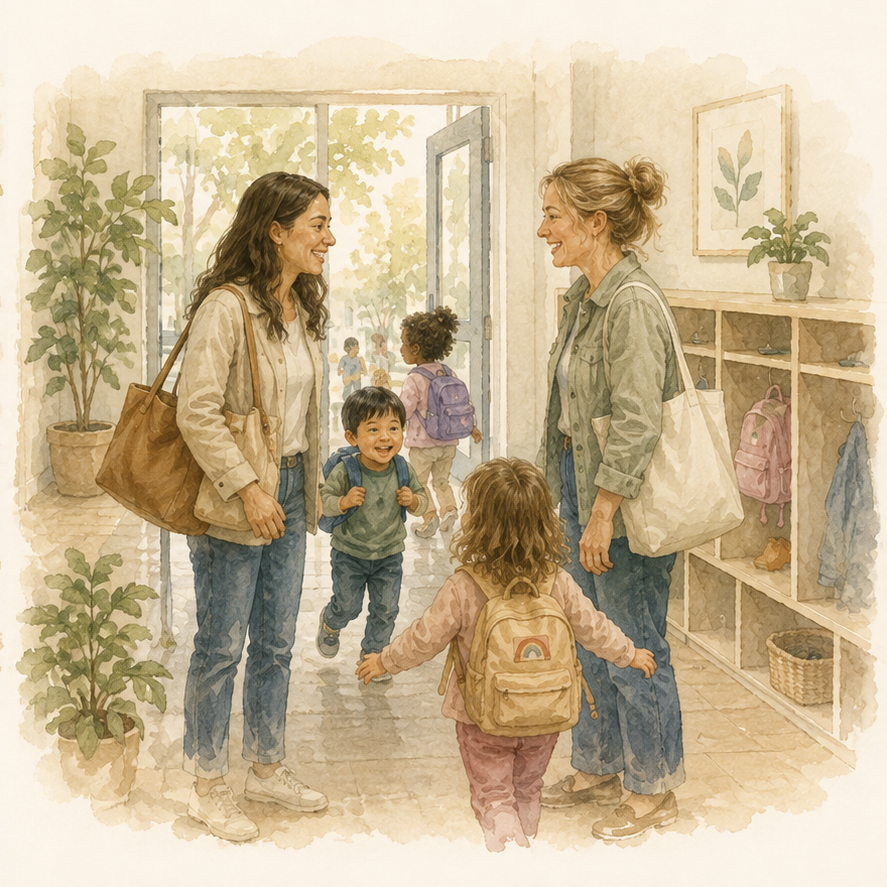
Drop-off conversations, school events, classroom friendships, and seeing the same families over time create opportunities for parents to connect. Children begin forming their school community — and families often find themselves becoming part of one as well.
And somewhere along the way, parents start finding each other, too.
Drop-off conversations, school events, classroom friendships, and seeing the same families over time create opportunities for parents to connect. Children begin forming their school community — and families often find themselves becoming part of one as well.
First, they learn the names of the children in their classroom.
Then you start learning the names of the parents standing beside you at pickup.
TWO-YEAR-OLD PRESCHOOL AT A GLANCE
The important things, all in one place.
THE PROGRAM
AGES
24–36 months
A preschool classroom for the developmental leap between toddlerhood and the increasingly independent preschool years.
APPROACH
Emergent curriculum
Children’s interests give us a starting point. Teacher knowledge turns those interests into deeper learning.
LEARNING
Literacy · Math · Science · Art
Concepts move through circle time, small groups, materials, books, conversation, exploration, and children’s own questions.
LITERACY
Composition notebooks begin here
Drawing, conversation, vocabulary, early writing, and storytelling create a record of development that continues as children grow through L&L.
SOCIAL DEVELOPMENT
Words · Self-control · Relationships
Children practice communicating what they need, hearing another person’s perspective, working through disagreements, and reconnecting afterward.
INDEPENDENCE
Doing more for themselves
Self-care, belongings, classroom responsibilities, choices, familiar directions, and potty learning when the child is ready.
THE EXPERIENCE AROUND IT
SPANISH
Dedicated Spanish teacher
Children build familiarity with another language through words, songs, movement, repetition, books, and age-appropriate concepts.
MUSIC
Outside music specialists · every week
Planned music and movement experiences give children opportunities to sing, listen, move, follow patterns, and participate together.
FAMILY CONNECTION
Brightwheel + teacher communication
Photos, updates, messages, and conversations help families stay connected to what children are learning, practicing, and experiencing at school.
CONFERENCES
Time to look more closely
Parent-teacher conferences give families and teachers space to talk about development, what we’re seeing at school and home, and what may be coming next.
COMMUNITY
Children aren’t the only ones building relationships
Classroom friendships, school experiences, familiar faces, and time together create natural opportunities for families to become part of the L&L community.
WHAT COMES NEXT
Preschool & Pre-K
Children carry forward stronger communication, greater independence, more group participation, and an increasing ability to stay with more involved learning.
COME SEE THE TWO-YEAR-OLD CLASSROOM
Come see what they’re capable of now.
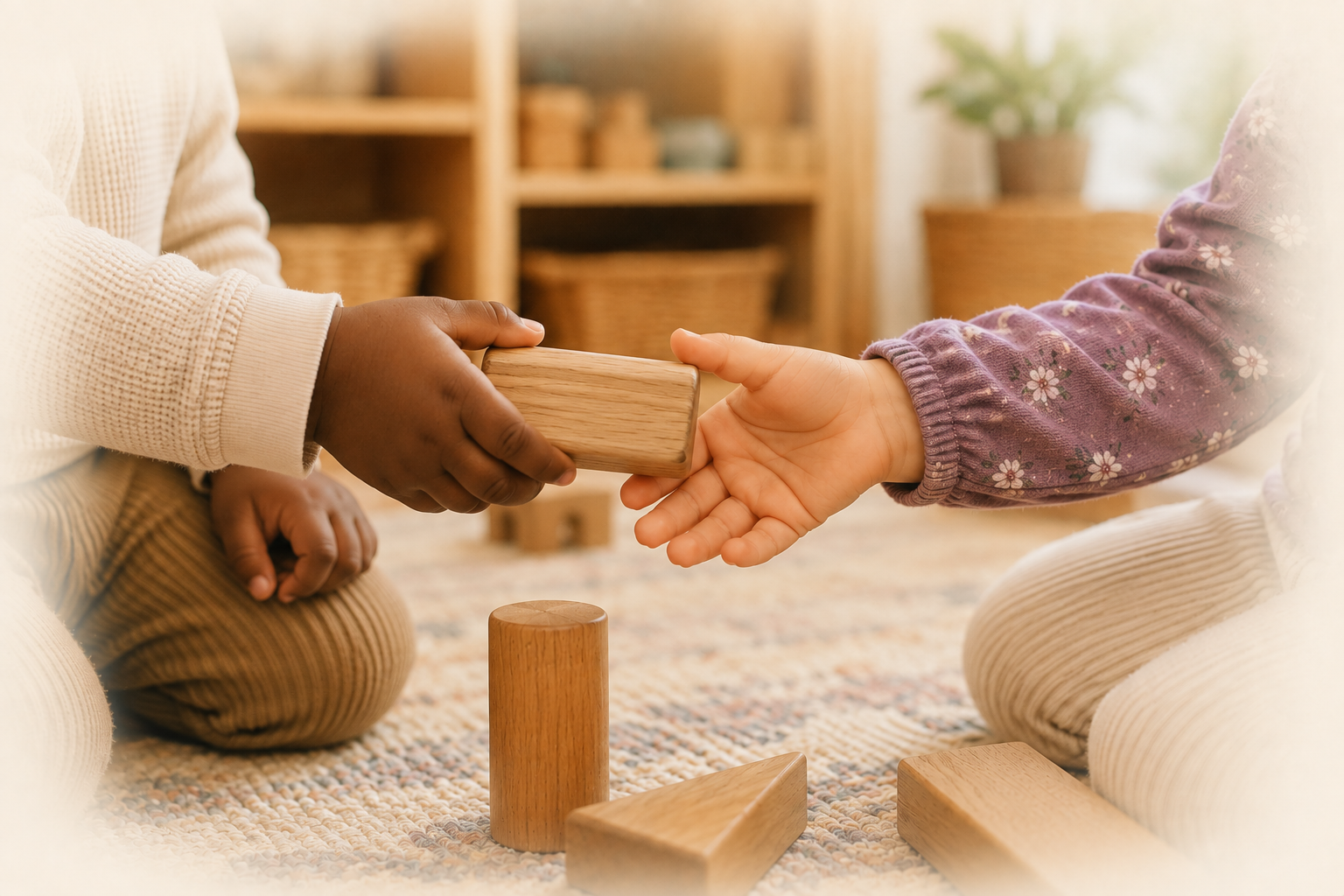
Two is an incredible age to watch up close. Come see children talking, creating, solving problems, working through disagreements, making choices, and discovering how much they can begin doing for themselves.
Look around the classroom. Watch how teachers speak with children, what they’re asking them to think about, and how much learning can be hidden inside something that looks very simple.
Most importantly, see whether you can picture your child here.
Start with a short inquiry to see tuition information right away, then choose an available tour time.
COME SEE THE TWO-YEAR-OLD CLASSROOM
Come see what they’re capable of now.
Two is an incredible age to watch up close. Come see children talking, creating, solving problems, working through disagreements, making choices, and discovering how much they can begin doing for themselves.
Look around the classroom. Watch how teachers speak with children, what they’re asking them to think about, and how much learning can be hidden inside something that looks very simple.
Most importantly, see whether you can picture your child here.
Start with a short inquiry to see tuition information right away, then choose an available tour time.
The first pages may begin with a few marks.
You’d be surprised how much can happen from there.